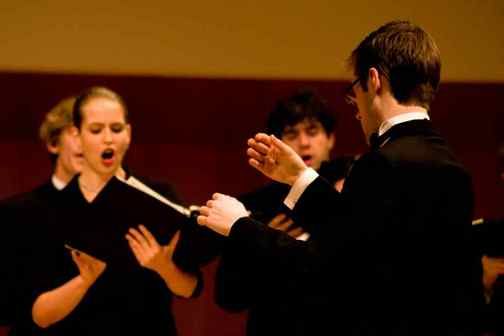
Marc Donnelly
______________________________________
Choral Director
Theory Pedagogue
Performer
______________________________________
Marc holds degrees from Bowdoin College in Mathematics, Music, and Teaching. He received a Masters of Music in
Choral Conducting from the University of Oklahoma and is currently a Ph.D. candidate in Music History and Theory specializing in music of the Renaissance.
He has worked extensively for an international music festival since 2005 and currently works in chamber music administration. In addition to numerous musical associations at various churches, Marc has assisted and cantored for High Anglo-Catholic masses, and currently directs a church choir and serves as organist for a Massachusetts parish. He is also an engaged vocal singer with various ensembles in addition to work as a soloist.
Marc has experience teaching from the elementary to collegiate levels and has recently lectured courses is music history, music theory, aural skills acquisition, piano and voice lessons, and choral repertoire.
Thoughts on Virtue - For All Aspects of Life
I will share two quotations from Cicero's De Amicitia (On Friendship), which I began contemplating, but first a bit of back-story. Basically, he says that you need to have virtue to be able to have friendship and love. Those who lack virtue cannot develop true friends. One can never ask too much (or unscrupulously) of a friend without destroying the bonds of friendship. To ask a friend to do something morally wrong would relieve them of their virtue. Still, one should not wait for an invitation to act in defense of a friend in need, but instead anticipate their need. Lastly, I gather that you cannot wish to avoid anxiety or stress in life. Some would say you should not concern yourself with the problems of others, but the virtuous man will always be concerned with injustice. It will worry him. We should be concerned and worried about starving children, the victims of domestic abuse, the ecologic devastation that is created through industrialization, and animal cruelty. If we can empathize with the troubles of the world, we are able to maintain virtue. Thus, if we wish to be virtuous and maintain friendship in our lives, we must have stress. We must be anxious. This seemed a particularly sobering thought to me!
“In the face of a true friend a man sees as it were a second self. So that where his friend is he is; if his friend be rich, he is not poor; though he be weak, his friend's strength is his; and in his friend's life he enjoys a second life after his own is finished. This last is perhaps the most difficult to conceive. But such is the effect of the respect, the loving remembrance, and the regret of friends which follow us to the grave. While they take the sting out of death, they add a glory to the life of the survivors.”
I was particularly enthralled with this passage because it highlights a concern that is revisited frequently by almost everyone I know. As individuals, we search for meaning in the world. Why are we here? We seek purpose. Some may even seek to do great things with their time on earth. Others may become teachers and hope that their impact will be seen through their students. By gaining a “second life,” Cicero professes that we can live on through our friends and lovers. In a way, when we develop these connections, we are giving a piece of ourselves to others. We are created from the world as a confluence of chemistry, biology, world events, life experiences, food eaten that was once grown from the earth, water and air consumed. It is only fitting and natural that we give a part of ourselves back to the world and others in it to complete the circle.
“And if any one thinks that this (Friendship) comes from a sense of weakness, that each may have some one to help him to his particular need, all I can say is that, when he maintains it to be born of want and poverty, he allows to friendship an origin very base, and a pedigree, if I may be allowed the expression, far from noble. If this had been the case, a man's inclination to friendship would be exactly in proportion to his low opinion of his own resources. Whereas the truth is quite the other way. For when a man's confidence in himself is greatest, when he is so fortified by virtue and wisdom as to want nothing and to feel absolutely self-dependent, it is then that he is most conspicuous for seeking out and keeping up friendships.”
For this second quotation, Cicero refers to the fact that some feel friendships are created for personal gain and is rebuking that claim. How many truly greedy, selfish people do you consider to be your true friend? Probably none. They are not trustworthy and often let us down. I think this connects to the concept of synergy in that virtue is essential to all friendship and love that we create in life. I have often wondered why things work out the way they do in splendid ways. Perhaps, the key to all of it is being virtuous. And that will affect your efforts on all other aspects of life.
Coincidentally, the Celestine Prophecy has randomly found its way into my discussions at various points over the last few weeks. While I have not read the book or seen the film, it has been explained to me that this synergistic principle grows throughout the film. Supposedly, there exists a transfer of energy, perhaps the aura of these people, between two individuals. One person’s aura can feed on another’s when in contact. Most “good” people’s aura’s are able to coexist without consuming the other because they do not intend to feed themselves on the other’s energy, but the protagonist has to learn how to do so. I see a parallel here to Cicero’s thought. Virtuous people do not try to personally gain by taking from others. If you feed on other people’s energy, you kill them (or a part of them) and will eventually be alone and friendless.
The idea that we need to see ourselves in others can be teased out to produce new insight. Try seeing and understanding life through another. We are often taught as children to imagine walking in someone else’s shoes to better understand and empathize with other viewpoint. Part of my musings have involved pondering how I could harness virtue to make my own life better and more fulfilling, but I can expand this concept to produce fairly radical ideas.
When we empathize with others and try to see things through their eyes, we invoke the divine. If you believe that God is omnipotent, then you acknowledge that he/she/it is able to at the very least see our point of view. While it is probably more accurate that God exists as the amalgamation of all people ideas and thoughts in addition to other cosmic forces, I will refrain from delving too deeply into this as my agnostic tendencies caution me against it.
I recently read in a blog, "I love the idea that God is God because he sees the world through every single eye that has ever existed, exists now, and will exist in the future. That's why he's omniscient... that's why he's omnibenevolent... and that's why he's omnipotent." Anna shared these verses with me as well:"The Spirit searches all things, even the deep things of God. 11 For who knows a person’s thoughts except their own spirit within them? In the same way no one knows the thoughts of God except the Spirit of God. 12 What we have received is not the spirit of the world, but the Spirit who is from God, so that we may understand what God has freely given us." -- 1st Corinthians 2:10b-12
After reading these passages, two ideas merge together for me. First, we approach divinity when we attain virtue and empathy. We attempt to see through the eyes of others. God is able to do this and more. He can go beyond seeing through the eyes of others to the point of existing within them and actually being them. I very consciously used the word “invoke” earlier to describe the effect of empathy. By allowing virtue to rule our daily lives, we are actually assimilating a bit of the divine into our essence.
The verses tell us that humans are only able to perceive the thoughts of others through communication, but not the essence or spirit of another person. God, on the other hand, is able to share his “spirit” with us. God wants us to know his thoughts and his self through the spirit. Are we capable of this to some extent? I think we are, but I don’t think we always realize it. Maybe it is just a very intense empathy, but I feel like there have been moments in my life when I can “feel” another person, their energy, their spirit. This has only happened with individuals whom I have loved, either as friends or romantically. Another possibility is that the spirit is capable of this, but our earthy bodies get in the way of this innate ability. Perhaps it is conditioning of the world acting upon us as mortal beings that prevents sharing our spirit with others. If heaven exists and if we are able to go there, would this ability be unlocked for us? Perhaps, every spirit in heaven is able to coexist with all others because they are all able to truly know the other spirits. The ability to truly know all others and empathize with them may be what makes heaven the peaceful and idyllic place we are taught that it is. Perhaps this is why we have strife on earth. We lack the ability to completely empathize with those around us. If we can accept empathy as paramount and eliminate fear from ourselves, could we eliminate war, famine, poverty?
Is there a collective unconscious to be discovered in all of this philosophy? Perhaps, we are able to completely connect in some way to another. Although, even if it were possible to connect and share thoughts and energy with one other person, I am pretty sure that I at least wouldn’t be able to do so with everyone else in the world (without exploding from the immensity of it all anyway). But what if we could? Could we harness omnipotence, omniscience, and omnibenevolence? I suggest we start with smaller steps. Take it one day and one person at a time. Try ending every day with a simple question: Have I made a conscious effort to be virtuous in everything that I did today? Let me know the results. I began asking myself this question recently and have been amazed by the immediate difference created by the synergy of virtue with all other aspects of my life.